
Instead, I found myself wedged between my screaming children in economy with separate Blueytheme songs blasting through unsynced iPads, reassessing every life choice that had brought me to this point. Reproducing with their half-Turkish Sephardi father Yosi “because he is very good looking” suddenly seemed like a questionable decision made by a naive 30-year-old who didn’t consider the inevitable trip we’d have to make in order for the children to meet their great grandmother, aunts, uncles and cousins who don’t travel further than Madrid.
The honest truth is yes, I was worried about antisemitism. I had read the reports of the bookshop with the “Jews not allowed” sign back in October 2023, an incident which Yosi’s Turkish cousin Semi asserted was a one-off act by “a really stupid person”.
I had steered the conversation towards anti-Jewish racism on our second night in Istanbul after a day trip to the Bosphorus adjacent mahalle of Ortaköy. Yosi had been looking forward to buying his favourite street food, Kumpir (a baked potato with toppings) and in order to reach the strip of market stalls, we had to manoeuvre our flimsy travel pram through narrow, uneven streets, past the touristy Nazar Boncuğu eye pendant, head scarf and chachitas (Ladino for chachkas) stands to the food vendors. Yosi and I were shocked to see that they were all plastered with “Free Palestine” signage.
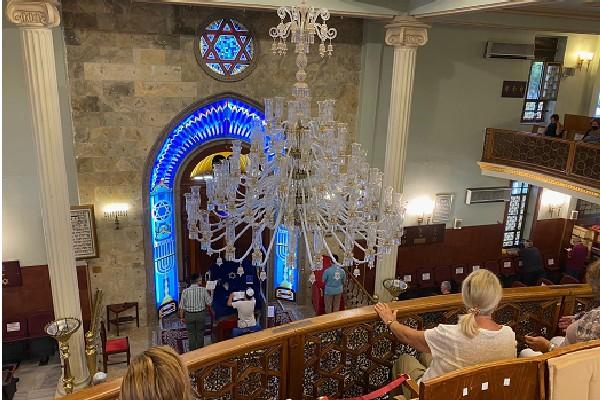
Cousin Semi maintained that while the population in Turkey was indeed very anti-Zionist, “intelligent and respectable” citizens understood the difference between Zionism and Judaism. In fact, Semi insisted that the aforementioned food vendors of Ortaköy treasure the Jewish community who have consistently purchased lunch from them after synagogue services at the local Etz Ahayim Synagogue for 100-plus years.
Yosi’s aunt Karel offered a slightly different perspective. Karel, aka esteemed Turkish academic and author Karel Valansi, specialises in Turkish-Israeli relations and has recently contributed to an anthology of essays Anti-Semitism in and from Turkey. Karel shared sentiments that can best be summarised by her quote in a Deutsche Welle news article from October 2023.
“What we see from the rhetoric of politicians, the press and social media is this: when Turkish-Israeli relations are not good, in the perception, Jews are completely removed from the position of citizens of the Republic of Turkey and turned into ambassadors and extensions of the state of Israel, and the anger against this state is directed toward Turkish Jews.”
All this despite a Jewish presence in Turkey since ancient times and most significantly after the Spanish Inquisition in 1492 when many Sephardic Jews, including Yosi and Karel’s ancestors, were expelled from Spain. Karel predicts that the current Turkish Jewish population of about 12,000 will soon dwindle further as Gen Zs leave for the USA, Israel, Italy, Portugal and Spain.
Sadly, the next generation won’t be offered the promise of a carefree future in these countries either, as even Western Europe has its own deep-seated Christian antisemitism.
Tell that to the Jewish holiday-goers currently “supporting an antisemitic country” over a lactose-heavy cheese plate in the south of France.
At this point, I should mention that we spent half of our trip on the small island of Büyükada in the Marmara Sea. The largest of the Princes Islands, Büyükada is a regular holiday destination and short ferry ride for Istanbul’s Jews - it even has its own synagogue. During this visit, we rented a teeny apartment from a Jewish family to offset the guilt about “supporting an antisemitic economy”.
On the island, we passed our days at a swim club with a large Jewish clientele (and even larger presence of loud and proud seagulls). It was here I met a mother who had chosen not to send her kids to their regular Jewish summer camp due to the discomfort following October 7. She also advised against visiting Büyükada’s Hesed LeAvraam Synagogue: “I don’t believe it is safe right now.”
So did I personally experience antisemitism while I was there? That seems to be the main question I’ve been asked upon my return. (If I had a hundred dollars for every… )
The answer is no and that’s almost certainly because we kept our Jewish identities hidden - as do many of the local Jews in Turkey. I saw one mezuzah during my stay (it belonged to a friend of the family) and I clocked one gentleman wearing a chai pendant in the safety of the Jewy swim club.
I’d like to argue that the 38-degree average temperature was antisemitic but that’s not really specific to Turkey right now, is it? Neither are chutzpadik seagulls. Plus, the bidet toilet was commonplace and is perhaps the most philosemitic invention ever.
Will I go back? Yes, when the kids are old enough to manage their own iPad settings, toileting and meals on the plane so I can pop a sleeping pill and see them again upon landing.
Qantas is about to launch a new direct flight from Melbourne to Istanbul. Alarmingly, it’s 18 hours and 15 minutes, which I think we can all agree is not just antisemitic, but downright misanthropic.
The Jewish Independent 1 August 2024 https://thejewishindependent.com.au/the-one-question-people-ask-me-when-i-get-home-from-turkey
Yorumlar